In an era of constant disruption, the question isn't whether your community will face crisis. It's whether you'll emerge stronger because of it. Research reveals a startling reality: while 70% of organizations struggle to recover from major setbacks, anti-fragile communities actually grow stronger through stress and challenge.
The difference isn't luck or resources. It's the systematic development of adaptive capabilities that transform uncertainty from weakness into competitive advantage. Communities that master this transformation see remarkable results: 60% higher survival rates during major disruptions, 40% better crisis response through distributed leadership, and 3x faster recovery from setbacks.
Whether you're leading a nonprofit through funding challenges, managing a team through organizational change, or building any community facing uncertain times, the frameworks for adaptive resilience can transform how you navigate disruption.
The best part? Building adaptive capacity isn't about predicting the future or avoiding all problems. It's about creating systematic approaches to learning, growing, and thriving regardless of what challenges emerge. Your community can become the kind that doesn't just survive change but actively uses it as fuel for growth and innovation.
When Diversity Becomes Strength Through Adversity
I once lived in a remarkably diverse community that brought together people from every imaginable background. We had homeless individuals and multi-millionaires, every race and creed, Native Americans, European Americans, Asian Americans, East Indian and Persian Americans, and countless others creating a rich tapestry of human experience.
Our community included people who had joined because of our community's commitment to establishing racial justice, which is a core tenant. They had been oppressed and ignored by society and desperately wanted to a find a community where they could find validation and appreciation for their struggles.
In addition to these people who were deeply concerned about social justice issues, we had elected leaders who tended to be in business, medicine, and technology. They had very different life experiences. Of course, racial justice was important, but so was all other aspects of running the complexities of community life. They were focused on efficiency and effectiveness. Their main goal was having productive meetings so we could get on with our busy lives.
Over time, this created a major culture clash that required extensive consultation. The process was painful and challenging as some members wanted to spend more time and resources on this most challenging of issues, while others were tyring to keep the lights on and the community running smoothly. It tested everyone's commitment to our shared values.
But here's what made the difference: nobody walked away. Despite the difficulty, everyone remained committed to figuring it out together. We all wanted to create a welcoming, empowering, and healing community that could serve as an example to the world.
The breakthrough came when the entire community chose to turn toward the pain rather than away from it. We conciously made time to let our longsuffering members bear witness to the deep scars they had experienced. We made time to validate their struggles instead of dismissing them. This willingness to truly tune in and listen to this collective suffering became the foundation of our community's healing.
For so many souls who had spent their entire lives ignored and fogotten, this experience offered them a healing path forward alongside us. And for those of us who had lived very different lives, this experience taught us not to get defensive or to be dismissive of the hurt, but instead be open to the process of sharing, validation, and healing.
That community's crisis taught me that adaptive communities aren't those that avoid conflict. They're the ones that lean into difficulty with courage and compassion, knowing that the process of working through challenges together creates bonds strong enough to weather any storm.
The Four Pillars of Adaptive Resilience
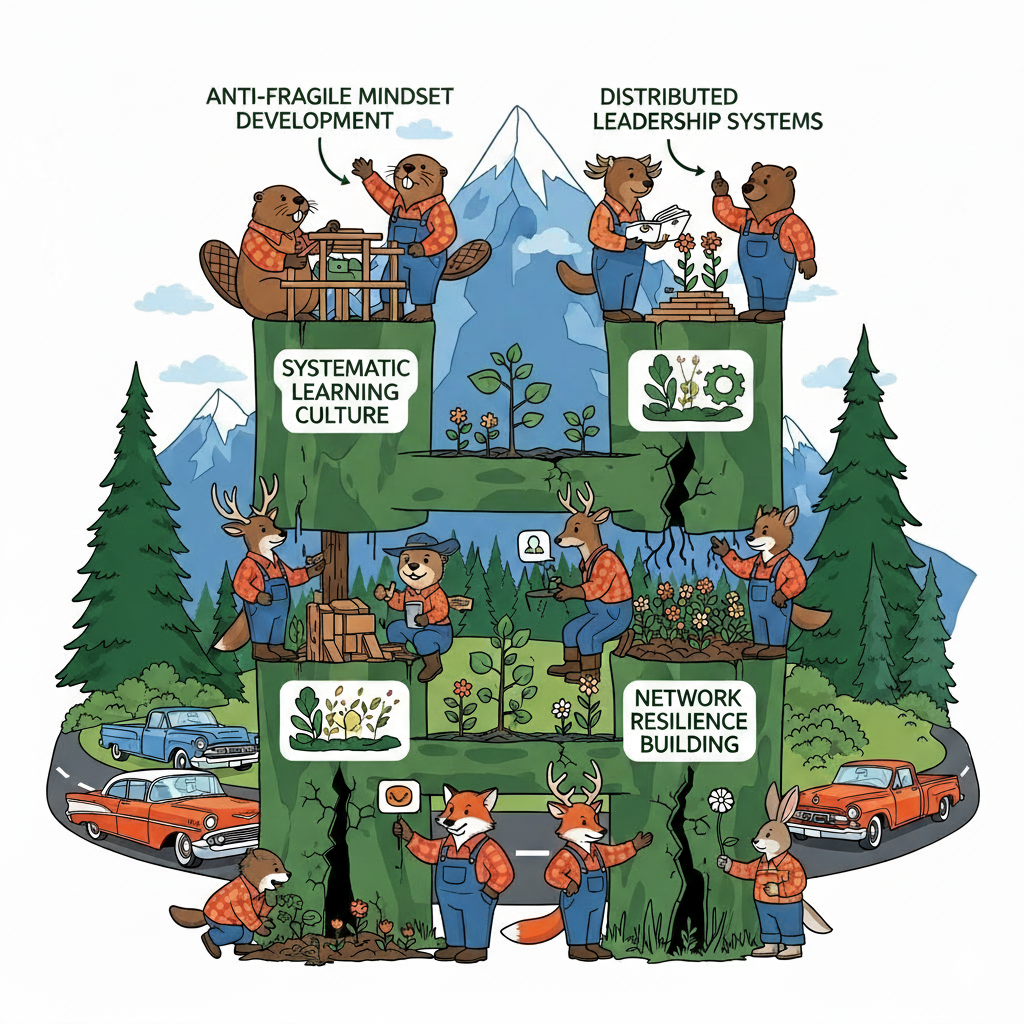
Building communities that thrive through change requires systematic development of four core capabilities that transform reactive responses into adaptive strengths.
Pillar 1: Anti-Fragile Mindset Development
Anti-fragile communities don't just bounce back from challenges. They use stress and disruption as catalysts for growth and improvement. This requires shifting from damage control to opportunity identification during difficult times.
Key elements include:
- Viewing challenges as growth opportunities rather than threats to survive
- Systematic learning extraction from both successes and failures
- Building redundancy and optionality into community structures
- Developing comfort with uncertainty and experimental approaches
In our diverse community, the culture clash could have destroyed us. Instead, it became the crucible that forged deeper understanding and stronger relationships across all our differences. We learned to see our tensions not as problems to solve but as creative energy to harness for validation, exploration, and growth.
Implementation strategies:
- Create "opportunity identification" sessions during crisis moments
- Develop storytelling practices that reframe challenges as growth catalysts
- Build multiple pathways to achieve important goals (redundancy)
- Establish safe-to-fail experimentation protocols
Pillar 2: Distributed Leadership Systems
Resilient communities spread decision-making authority and responsibility across multiple people and levels. This creates multiple centers of strength and reduces the risk of single points of failure during crisis.
Essential components:
- Clear delegation of authority for different scenarios and situations
- Multiple people trained in critical leadership functions
- Cross-functional teams with diverse skills and perspectives
- Succession planning that maintains institutional knowledge
When crisis hits, distributed leadership ensures that someone is always prepared to step up and respond effectively, regardless of who might be unavailable. In our community, this meant that business leaders learned to let go of control and efficiency for a while, and facilitate healing conversations that needed to happen for us to move forward.
Implementation strategies:
- Map all critical functions and cross-train multiple people for each
- Create decision-making matrices that clarify authority levels
- Rotate leadership responsibilities to build broad-based capacity
- Establish mentorship programs that transfer institutional knowledge
Pillar 3: Systematic Learning Culture
Adaptive communities institutionalize the process of learning from experience. They create regular cycles of reflection, analysis, and improvement that compound over time into exceptional adaptive capacity.
Core practices include:
- Regular after-action reviews following both successes and failures
- Documentation and sharing of lessons learned across the community
- Experimentation protocols for testing new approaches safely
- Knowledge management systems that preserve institutional wisdom
Our community's willingness to engage in difficult conversations and learn from our conflicts created a template for navigating future challenges with greater skill and confidence. We became experts at facing into the pain and extracting wisdom from our struggles.
Implementation strategies:
- Schedule reflection sessions after every major initiative or crisis
- Create standard templates for capturing lessons learned
- Establish a community library of best practices and case studies
- Design feedback loops that connect learning to future planning
Pillar 4: Network Resilience Building
Strong communities don't stand alone. They build diverse networks of relationships and partnerships that provide mutual support, shared resources, and collective problem-solving capability during challenging times.
Critical elements:
- Strategic partnerships with complementary organizations
- Mentorship relationships that transfer knowledge and experience
- Resource-sharing agreements that provide backup during crisis
- Community of practice participation for ongoing learning and support
Networks create the external connections that help communities access resources, ideas, and support that might not exist internally. Our diverse community became part of larger networks focused on racial healing, interfaith dialogue, and community development.
Implementation strategies:
- Map current network connections and identify gaps
- Develop formal partnership agreements with aligned organizations
- Participate actively in relevant communities of practice
- Create resource-sharing protocols with trusted partners
The Research Behind Adaptive Resilience
The evidence for systematic resilience building is compelling. MIT Sloan Management Review research shows that anti-fragile organizations are 60% more likely to survive major disruptions. This isn't about avoiding challenges but about systematic preparation for uncertainty.
Harvard Kennedy School studies reveal that communities with distributed leadership have 40% better crisis response capabilities. When multiple people share responsibility and authority, communities can respond more quickly and effectively to unexpected challenges.
The learning dimension proves equally crucial. McKinsey Global Institute research demonstrates that organizations with learning cultures are 92% more likely to develop novel solutions to complex problems. This capability becomes essential when communities face unprecedented challenges that require creative responses.
"The only way to make sense out of change is to plunge into it, move with it, and join the dance."
Eric Hoffer, social philosopher, identified the critical distinction: "In times of change, learners inherit the earth, while the learned find themselves beautifully equipped to deal with a world that no longer exists." This highlights why learning culture trumps accumulated knowledge during disruption.
Clayton Christensen from Harvard Business School offers strategic perspective: "The future belongs to organizations that can turn uncertainty into competitive advantage." This transformation from liability to asset defines adaptive mastery.
The Resilience Research Centre confirms the practical impact: adaptive communities recover from setbacks 3x faster than traditional organizations, while Nonprofit Quarterly research shows they sustain impact 50% longer.
Three Steps to Build Adaptive Resilience
Step 1: Assess Your Community's Current Adaptive Capacity (Week 1-2)
Conduct a comprehensive resilience audit across all four pillars. Identify your community's strongest adaptive capabilities and most vulnerable areas. Map your current decision-making structures, learning processes, and external networks.
Key assessment areas:
- How does your community typically respond to unexpected challenges?
- Who has decision-making authority in different types of crisis situations?
- What systems exist for capturing and sharing lessons learned?
- Which external relationships provide mutual support during difficult times?
- How quickly can your community pivot strategies when circumstances change?
Assessment tools to create:
- Resilience scorecard covering all four pillars
- Crisis response timeline from recent challenges
- Leadership capacity map showing skill distribution
- Learning system inventory documenting current practices
- Network relationship audit identifying strength and gaps
Step 2: Implement Distributed Leadership Structures (Week 3-6)
Begin spreading leadership capacity across your community through systematic delegation and skill development. Create clear protocols for decision-making authority during different scenarios and train multiple people in critical functions.
Essential elements:
- Document all critical leadership functions and cross-train multiple people
- Establish clear decision-making protocols for various crisis scenarios
- Create leadership development pathways for emerging community members
- Implement regular leadership rotation to build broad-based capability
- Design succession planning systems that maintain institutional knowledge
Focus on immediate wins:
- Identify the three most critical leadership functions in your community
- Cross-train at least two additional people for each function
- Create decision-making authority matrices for common scenarios
- Establish regular leadership team meetings that include emerging leaders
- Document key processes so knowledge isn't trapped in individual minds
Step 3: Establish Learning and Adaptation Cycles (Week 7-12)
Create systematic processes for extracting wisdom from both successful and challenging experiences. Build these learning cycles into your community's regular rhythm so adaptation becomes automatic rather than reactive.
Systematic learning implementation:
- Schedule regular reflection sessions after major initiatives or events
- Create templates for documenting lessons learned and best practices
- Establish protocols for rapid experimentation when facing new challenges
- Build feedback loops that connect learning to strategy and planning processes
- Develop knowledge sharing systems that preserve and transfer institutional wisdom
Ongoing practices to establish:
- Monthly "lessons learned" sessions for significant community activities
- Quarterly strategy adjustment meetings based on accumulated learning
- Annual resilience assessment and adaptation planning sessions
- Regular experimentation with new approaches in low-risk situations
- Community knowledge base that captures and shares institutional wisdom
Growing Stronger Through Whatever Comes
Building adaptive resilience isn't about predicting the future or avoiding all challenges. It's about systematically developing the capabilities that help communities thrive regardless of what changes emerge. When communities master the four pillars of adaptive resilience, they transform uncertainty from weakness into competitive advantage.
My experience in a highly diverse community taught me that the most resilient communities aren't those that avoid conflict but those that lean into difficulty with courage and adaptive approaches. By building anti-fragile mindsets, distributed leadership, learning cultures, and network resilience, any community can develop the adaptive capacity that turns challenges into opportunities for growth.
The process isn't always comfortable. In our community, the journey from cultural clash to cohesive strength required months, if not years, of difficult conversations, painful honesty, and persistent commitment to growth. But the result was a community that could handle any challenge because we had learned to transform conflict into connection and adversity into advantage.
Your community faces an inevitable choice: remain reactive and vulnerable to whatever disruption comes next, or proactively build the adaptive capacity that enables thriving through uncertainty. The research is clear, the frameworks are proven, and the time to start is now.
Ready to build adaptive resilience in your community? Northwest Innovation Group offers workshops and consultation services that help organizations develop systematic approaches to thriving through change and uncertainty.
Start your transformation:
Submit a project through our website to explore adaptive resilience strategies for your specific context, attend one of our resilience-building workshops, or schedule consultation to develop your customized adaptation plan. Let's help your community move from reactive survival to adaptive thriving.