
Consultation

Creating Psychological Safety in Community Consultations: The Key to Honest Input

Learn how to create psychological safety in community consultations to unlock honest input and diverse perspectives. Discover proven facilitation techniques that build trust and encourage authentic participation.

Creating Psychological Safety Cover

What separates consultations where people share their real thoughts from those where everyone just nods politely? The answer isn't better questions or more structured agendas. It's psychological safety: the shared belief that people can speak up without risk of punishment, humiliation, or negative consequences.

Research reveals striking results: teams with psychological safety are 67% more likely to learn from failures, while organizations with inclusive cultures are 70% more likely to capture new markets. When people feel safe to contribute authentically, psychological safety increases honest feedback by 64% in group settings.

Whether you're facilitating board meetings, leading community planning sessions, or managing any group consultation process, creating psychological safety can transform superficial discussions into powerful problem-solving conversations that generate real solutions.

The best part? Building psychological safety isn't about complex psychology or years of training. It's about specific, learnable techniques that any facilitator can implement immediately to create environments where diverse perspectives flourish and honest input drives better decisions.

When Leadership Means Making Sure Everyone Else Is Okay

I once joined an online men's group to see what it was all about. I had been feeling very lonely after a long period of struggling and I wanted to cultivate some new friendships. These men's groups had been in my mind for a while. They offered a place for men to talk about their lives in an open and validating way, without judgment or prejudice. I wasn't sure how it would go for my first meeting though. I tend to be a private person.

When the group showed up, I immediately felt out of my element. The members were very different from what I expected. Their socioeconomic background, age, and life situations were very different from mine. I could feel myself withdrawing, second-guessing whether I belonged in this space.

I think the moderator of the group could tell I was uncomfortable. Without making a big deal about it, he began to sit next to me and provide a bit of a buffer. He invited me into the conversations in a fun and easy way, and he made the meeting much more engaging than it could have been. When I hesitated to share something personal, he created space for me by sharing his own vulnerability first.

I really appreciated his extra effort. It wasn't really his job. We were all there on our own. But he had taken on the responsibility to make sure everyone felt welcome. And it really helped me feel safe enough to participate authentically.
That experience reminded me of a powerful leadership principle: sometimes leadership means making sure everyone else is okay. This moderator understood that psychological safety isn't created by accident. It requires intentional facilitation that helps people feel secure enough to contribute their real thoughts and experiences.

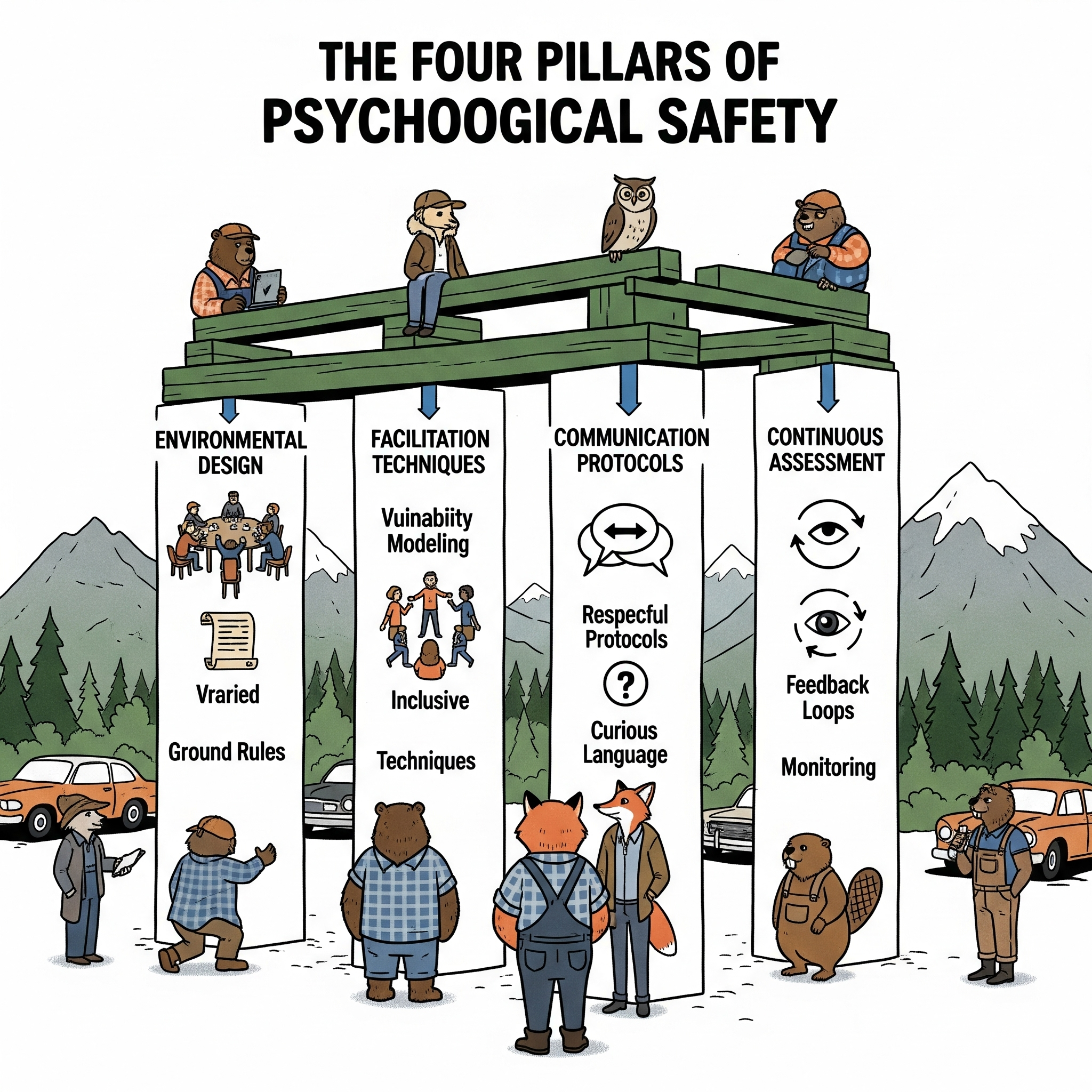
Four Pillars of Psychological Safety

The Four Pillars of Psychological Safety in Consultations

Creating environments where people feel safe to contribute authentically requires systematic attention to four core elements that work together to build trust and encourage honest participation.

Pillar 1: Environmental Design and Setup

The physical and emotional environment sets the stage for psychological safety before anyone speaks. This includes both tangible elements and intangible atmosphere creation.

Key elements include:

  • Seating arrangements that promote equality rather than hierarchy
  • Clear ground rules established collaboratively at the beginning
  • Explicit permission for disagreement and diverse perspectives
  • Confidentiality agreements when discussing sensitive topics
  • Multiple ways for people to contribute (verbal, written, anonymous)

In my men's group experience, the moderator's decision to sit next to me wasn't accidental. He was intentionally designing the environment to help me feel included and supported. When facilitators pay attention to physical setup and emotional tone-setting, they create conditions where psychological safety can flourish.

Pillar 2: Facilitation Techniques That Reduce Fear

Skilled facilitators use specific methods to minimize the social risks that prevent authentic participation while maximizing opportunities for meaningful contribution.

Essential techniques:

  • Starting with low-stakes sharing before moving to more sensitive topics
  • Modeling vulnerability by sharing appropriate personal examples
  • Using structured input methods that ensure equal participation
  • Actively inviting quieter voices without putting them on the spot
  • Redirecting criticism toward ideas rather than people

Pillar 3: Communication Protocols for Honest Exchange

Systematic approaches to how information is shared and received create predictable safety that enables people to take interpersonal risks necessary for authentic input.

Core protocols include:

  • "Yes, and..." responses that build on rather than shut down ideas
  • Separating idea generation from evaluation to prevent premature judgment
  • Using neutral, curious language rather than defensive or dismissive responses
  • Implementing "pause and reflect" moments before responding to controversial input
  • Creating explicit norms around respectful disagreement

Pillar 4: Continuous Safety Assessment and Improvement

Psychological safety isn't a one-time achievement but an ongoing practice that requires regular monitoring and adjustment based on group dynamics and feedback.

Assessment and improvement practices:

  • Regular check-ins about how safe people feel to contribute honestly
  • Anonymous feedback collection about consultation effectiveness
  • Observation of participation patterns and speaking time distribution
  • Post-consultation debriefs that address both content and process
  • Continuous facilitator skill development and peer learning

The Research Behind Psychological Safety

The evidence for psychological safety's impact on group effectiveness is compelling. Google's Project Aristotle research demonstrates that "the highest-performing teams have one thing in common: psychological safety," as Harvard Business School professor Amy Edmondson notes. This isn't just about feeling good; it's about measurable performance improvements.

"Fear is the enemy of learning, and learning is the key to adaptation."

Edgar Schein, MIT Sloan School

Teams with psychological safety are 67% more likely to learn from failures, according to Google's extensive research. This learning capability becomes crucial during consultations where groups need to surface problems, examine mistakes, and generate innovative solutions.

Three Steps to Build Psychological Safety in Your Consultations

Step 1: Design Safety Into Your Process (Week 1)

Before your next important consultation, intentionally structure the environment and process to encourage authentic participation rather than political performance.

Step 2: Develop Safety-Building Facilitation Skills (Weeks 2-3)

Practice specific techniques that help participants feel secure enough to share honest thoughts and concerns without fear of negative consequences.

Key facilitation skills:

  • Model appropriate vulnerability by sharing your own uncertainties or challenges
  • Use curious, non-defensive language when responding to difficult input
  • Implement structured input methods that ensure equal participation opportunities
  • Redirect criticism toward ideas and solutions rather than personal attacks
  • Create explicit pauses for reflection before responding to controversial topics

Step 3: Assess and Continuously Improve Safety (Ongoing)

Regularly evaluate how safe participants feel and adjust your approach based on feedback and observation of group dynamics.

Assessment methods:

  • Conduct anonymous surveys about consultation effectiveness and comfort levels
  • Monitor participation patterns and speaking time distribution across different participant types
  • Schedule post-consultation debriefs that address both content outcomes and process experience
  • Gather specific feedback about what made participants feel safe or unsafe to contribute honestly
  • Track changes in input quality and authenticity over time as safety practices improve

Building Trust That Transforms Consultation

Creating psychological safety in community consultations isn't just about making people feel comfortable. It's about unlocking the honest input and diverse perspectives that drive better decisions and stronger solutions. When participants feel safe to contribute authentically, consultations transform from polite performance to powerful problem-solving.

The research is clear: psychological safety increases honest feedback by 64% and makes teams 67% more likely to learn from failures. These aren't soft benefits. They're competitive advantages that enable communities to make better decisions and adapt more effectively to challenges.

Ready to transform your consultations through psychological safety? Northwest Innovation Group offers facilitation training and consultation services that help leaders create environments where authentic input thrives.

Related Articles

Consultation
Eliminating Groupthink: 7 Science-Backed Techniques for Better Community Decisions

Discover 7 science-backed techniques to eliminate groupthink and improve community decision-making.

Read More
Consultation
The Consultation Revolution: Why Better Meetings Create Stronger Communities

Discover how better meetings transform into community-building powerhouses.

Read More

Ready to Apply These Insights?

Let's discuss how our workshops and consulting services can help you implement these strategies in your community.

Schedule a Consultation Read More Articles