What if the room full of brilliant minds making your community's most important decisions is actually making them worse? Research reveals a startling truth: groups make worse decisions than individuals 73% of the time when cognitive bias isn't addressed. The culprit isn't stupidity or lack of information. It's groupthink.
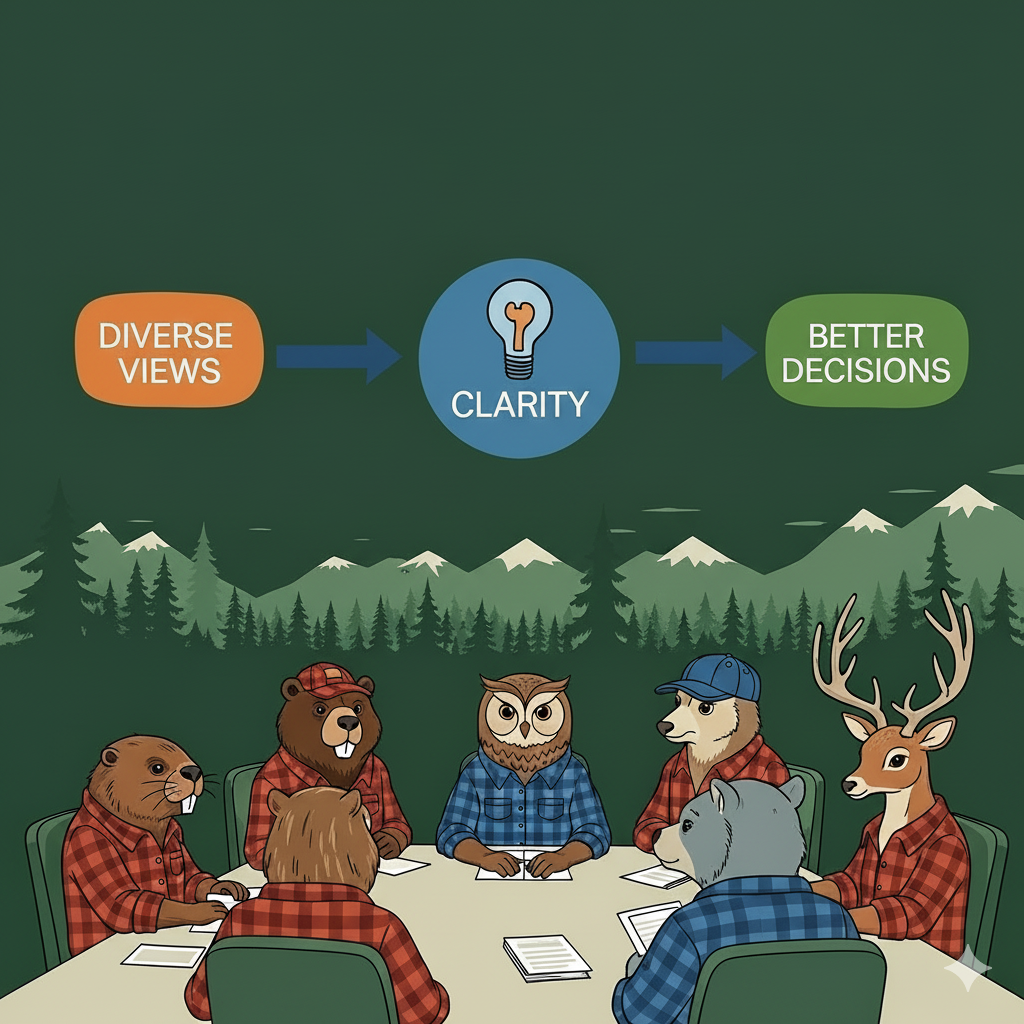
Groupthink creates an illusion of consensus while systematically excluding the diverse perspectives that lead to breakthrough solutions. But as we will see in this article, communities that implement systematic bias mitigation see remarkable results: 35% improvement in decision quality, 42% better ideas through anonymous input, and 87% superior performance when diverse teams use proven techniques.
The solution isn't replacing group decisions with individual ones. It's implementing seven science-backed techniques that harness collective intelligence while eliminating the cognitive traps that sabotage smart teams.
Whether you're leading board meetings, facilitating community planning sessions, or managing any group decision-making process, these evidence-based strategies will transform how your community thinks together. The best part? These aren't complex methodologies requiring extensive training. They're practical techniques you can implement in your next meeting to immediately improve decision quality.
When Fresh Perspectives Break Old Patterns
For over two decades, our local community had been stuck in a frustrating cycle. We used the same core activities, same types of events, same messaging, over and over. And predictably, we got the same disappointing results. In fact, because we weren't growing or bringing in fresh perspectives, we were effectively stagnating, and dying off as we aged. The community was slowly disintigrating before our eyes.
Everything changed when a few new families moved in and the old guard finally stepped aside. These newcomers had experience from much livelier communities and brought revolutionary ideas: new ways of connecting people, technology and social media strategies we'd never considered, and event formats that created value for everyone, not just longtime members.
The old guard was initially suspicious of these "new ways." But they recognized something crucial: they were tired of the same failed approaches, and they needed to make room for fresh thinking. Not only that, they were ready to hand over leadership and provide support rather than resistance.
The transformation was remarkable. Within six months, participation increased, engagement soared, and the community started attracting new members for the first time in years. The difference wasn't just new people. It was better decision-making that welcomed diverse perspectives instead of defaulting to groupthink.
This experience taught me that the most dangerous phrase in community decision-making isn't "we can't afford it" or "it's too risky." It's "we've always done it this way."
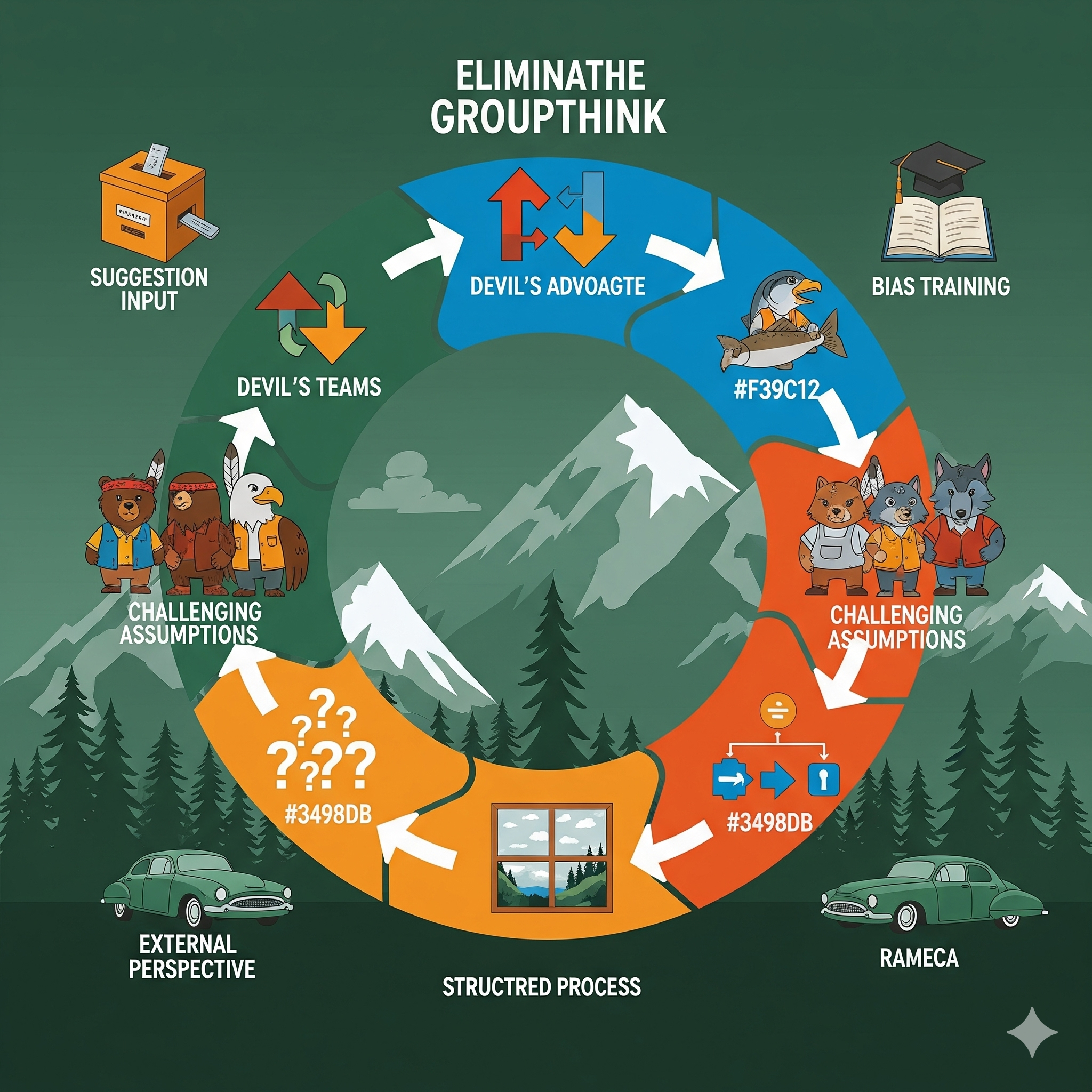
The 7 Science-Backed Techniques for Eliminating Groupthink
Technique 1: Anonymous Input Collection
Remove social pressure and hierarchy from idea generation by allowing people to contribute thoughts without attribution. According to Vorecool.com, research indicates that 70% of employees feel hesitant to voice concers openly at their organizations. This is because it eliminates fear of judgment and encourages honest perspectives.
Implementation strategies:
- Use digital tools for anonymous suggestion collection
- Conduct anonymous surveys before controversial decisions
- Create "idea boxes" for ongoing input gathering
- Review anonymous feedback before group discussions
In our community transformation, anonymous input revealed concerns and suggestions that longtime members had never felt comfortable sharing openly. The hierarchical structure had been silencing valuable perspectives for years.
Technique 2: Devil's Advocate Protocol
Systematically ensure that the group challenge prevailing assumptions and identify potential flaws in proposed solutions. Even if the path forward seems clear, it can be extremely valuable to 'steel man' the arguments against what seems obvious. You can assign someone to do this, or you can just make time to think through the arguments as a group. Either way, this ensures critical examination happens even when everyone seems to agree.
Implementation strategies:
- Rotate a "devil's advocate" or "existential questioner" role among team members
- Make challenging assumptions an explicit meeting agenda item
- Reward constructive dissent and contrarian thinking
- Create safety for expressing unpopular viewpoints
Our community's old guard naturally filled this role at first for the community. We had to work with them to turn the negative energy into a honest questioning spirit. Once we did this, we could rely on them to keep us honest, ensure we through through alternatives, and showed care. But they also knew that once the alternatives were considered, it was time to commit to whatever decision we had gone with. This helped us immensly to maintain cohesion and learn together.
Technique 3: Diverse Team Assembly
Intentionally include people with different backgrounds, expertise, and perspectives in decision-making processes. A Cloverpop study revealed that diverse teams outperform homogeneous teams by 87%.
Implementation strategies:
- Map stakeholder groups affected by decisions
- Include voices from different organizational levels
- Seek perspectives from outside your usual circles
- Rotate meeting participation to include fresh viewpoints
Our community's breakthrough came precisely because we expanded who was included in decision-making. The new families brought perspectives shaped by different community experiences, breaking us out of our echo chamber.
Technique 4: Assumption Challenging Sessions
Regularly examine and question the underlying beliefs that guide your community's approach. What seems "obvious" often contains hidden biases that limit possibilities.
Implementation strategies:
- List assumptions underlying current strategies
- Ask "What if this assumption is wrong?"
- Research how other communities approach similar challenges
- Test assumptions through small experiments
We discovered that many of our community's "core principles" were actually outdated assumptions about what we thought people wanted. Challenging these beliefs opened up entirely new possibilities for engagement. Instead of making assumptions, we challenged ourselves to research reality. We went out and researched first-hand with the intention of learning what people wanted. This gave us fresh information and a commitment to reality-based decisions.
Technique 5: Structured Decision Processes
Use systematic frameworks that guide groups through comprehensive analysis rather than jumping to quick conclusions based on initial impressions.
Implementation strategies:
- Separate idea generation from evaluation phases
- Use decision matrices for complex choices
- Implement "sleep on it" policies for major decisions
- Create checklists for decision quality assessment
Moving from intuitive decisions to structured processes helped our community make choices based on evidence rather than emotion or tradition.
Technique 6: External Perspective Integration
Regularly seek input from people outside your community who can spot blind spots and offer fresh insights that internal members might miss.
Implementation strategies:
- Invite outside observers to important meetings
- Conduct focus groups with non-members
- Study how other communities handle similar challenges
- Create advisory relationships with external experts
The new families essentially served as external perspectives within our community. Their outsider status allowed them to see opportunities and problems that longtime members had become blind to.
Technique 7: Bias Awareness Training
Educate your community about common cognitive biases and their impact on group decision-making. One the best things that can reduce biases is to just become aware of them.
Implementation strategies:
- Conduct workshops on cognitive biases
- Create bias reference cards for meeting facilitation
- Practice bias identification exercises
- Establish bias check protocols for important decisions
Understanding confirmation bias, status quo bias, and other cognitive traps helped our community recognize when we were falling into predictable thinking patterns.
The Science Behind Better Group Decisions
The research is overwhelming: traditional group decision-making is systematically flawed. Groups make worse decisions than individuals 73% of the time when bias isn't addressed, according to Psychological Science research. This isn't because groups lack intelligence. It's because they fall into predictable cognitive traps.
The Behavioral Economics Research Institute identifies the core problem: "The biggest enemy of good decision making is unconscious bias." These mental shortcuts that help individuals process information quickly become liabilities in group settings where confirmation bias and social pressure amplify errors.
But the solution isn't abandoning group decisions. It's implementing systematic bias mitigation. Teams using structured consultation show 35% improvement in decision quality, according to Organizational Behavior and Human Decision Processes research. Anonymous input alone increases idea quality by 42% in group settings.
"The first principle is that you must not fool yourself and you are the easiest person to fool."
The Diversity Research Institute provides crucial insight: "Diversity isn't just the right thing to do; it's the smart thing to do." When diverse teams implement bias mitigation techniques, they outperform homogeneous teams by 87%, according to Academy of Management Journal research.
Even the 18th-century philosopher Voltaire understood the key principle: "Judge a man by his questions rather than his answers." The techniques that eliminate groupthink focus on asking better questions rather than rushing to comfortable conclusions.
As quality management pioneer W. Edwards Deming advised: "In God we trust; all others must bring data." Systematic bias mitigation brings data and evidence to decision-making processes that too often rely on intuition and groupthink.
Three Steps to Implement Groupthink Elimination
Step 1: Assess Your Current Decision-Making (Week 1)
Evaluate how your community currently makes important decisions. Identify which of the seven techniques you're already using and which are missing. Map your typical decision-making participants and look for diversity gaps or bias patterns.
Key questions to answer:
- Who typically speaks most and least in your meetings?
- What assumptions underlie your community's current strategies?
- When was the last time your group changed course based on new information?
- How do you currently handle dissenting opinions?
Step 2: Start with High-Impact, Low-Risk Changes (Weeks 2-3)
Implement anonymous input collection and devil's advocate or strawman protocols in your next important meeting. These techniques require minimal training but create immediate improvements in perspective diversity and critical thinking.
Quick wins to implement:
- Send anonymous surveys before your next major decision
- Assign someone to play devil's advocate for each agenda item or
- Ensure you set aside time to 'strawman' the opposing or alternative approach together
- Invite one new voice to your regular decision-making meetings
- Create a "assumption challenge" segment in meetings
- Try having premortem instead of a postmortem This is where you assume things will fail and explore possible reasons for the failure and what you could have done differently.
Step 3: Systematically Add Additional Techniques (Weeks 4-8)
Gradually integrate assumption challenging sessions, diverse team assembly, and structured decision processes. Focus on one new technique every two weeks to allow proper integration and skill development.
Progressive implementation:
- Week 4-5: Add structured decision matrices for complex choices
- Week 6-7: Establish external perspective integration practices
- Week 8+: Implement bias awareness training for all participants
Ongoing: Monitor and Measure Improvement
Track decision quality improvements using both quantitative metrics (implementation success, outcome achievement) and qualitative feedback (participant satisfaction, perspective inclusion). The goal is creating a culture where bias mitigation becomes automatic rather than forced.
Breaking Free from Predictable Mediocrity
Eliminating groupthink isn't about making group decisions slower or more complicated. It's about making them systematically better by harnessing collective intelligence while avoiding collective blind spots.
The seven techniques outlined here have helped communities transform their decision-making from reactive groupthink to proactive collaboration. Like our local community that broke free from decades of stagnation, your organization can achieve breakthrough results by welcoming diverse perspectives and implementing bias mitigation systematically.
The choice is clear: continue defaulting to groupthink patterns that produce predictable mediocrity, or adopt evidence-based techniques that consistently generate better decisions and stronger community outcomes.
Ready to eliminate groupthink and improve your community's decision-making? Northwest Innovation Group offers workshops and consultation services that help organizations implement systematic bias mitigation and consultation excellence.
Start your transformation:
Submit a project through our website, attend one of our consultation workshops, or schedule a consultation to develop your customized decision-making improvement plan. Let's help your community harness collective intelligence while avoiding the cognitive traps that sabotage smart teams.