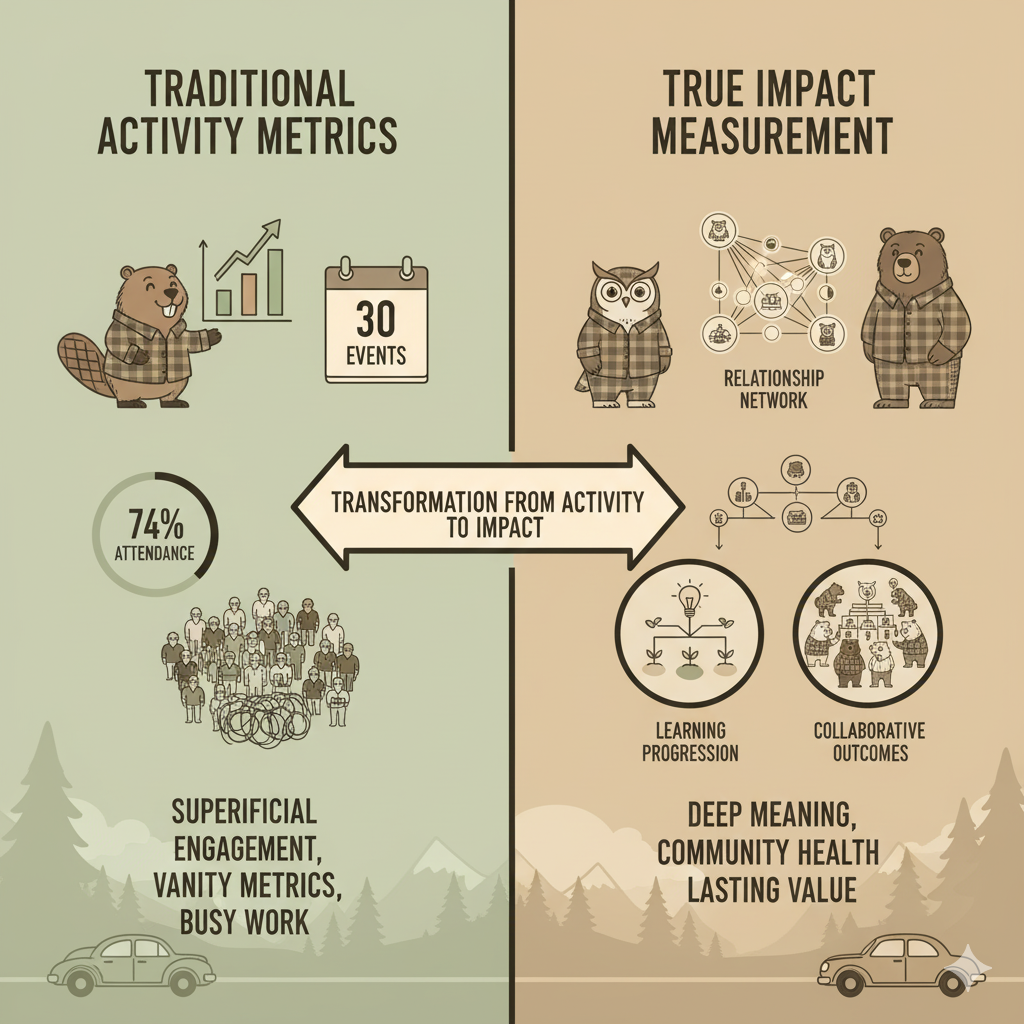
How do you know if your community building efforts are actually working? Most organizations track impressive numbers that mask a troubling reality: busy activity doesn't equal meaningful impact. Research reveals that only 35% of nonprofits measure actual community impact versus activities, yet organizations with clear metrics are 40% more likely to achieve their goals.
The difference between thriving and struggling communities isn't the volume of programs they run or the number of people who show up. It's their ability to measure what truly matters: relationship quality, learning effectiveness, collaborative problem-solving success, and sustainable community health.
Whether you're leading a nonprofit drowning in activity metrics, managing a team that feels busy but not productive, or building any community that needs to demonstrate real value, understanding the difference between measurement and true impact assessment can transform your effectiveness.
The best part? Moving from activity tracking to impact measurement isn't about complex analytics or expensive software. It's about asking better questions, designing smarter indicators, and creating measurement systems that reveal the health of your community relationships rather than just counting participation numbers.
When Impressive Numbers Hide Troubling Reality
I once worked with a group that had been highlighted as an exemplary model for the wider community. On paper, they looked incredible. Regular core activities, consistently high engagement numbers, and an impressive track record of over 60 intensive programs over the past decade. Leadership held them up as proof that systematic programming worked.
What we discovered when we arrived was that the numbers masked a stark reality. Despite all that busywork, there was little genuine impact to show for years of effort. The same people were having the same discussions over and over, just changing the buzzwords to match whatever was the latest guidance from headquarters.
It was heartbreaking to think about all the hours spent preparing, running, and following up on activities that generated impressive statistics but created no lasting change. Yet the people involved kept showing up, believing they were playing the long game. Unfortunately, they were just running in circles.
This group had become expert at avoiding innovation and shutting down "rogue ideas." Anyone who suggested different approaches was told they "didn't see the big picture." In business, we call this a doom loop: endless activity that prevents the very change it claims to pursue.
The saddest part was that these were good people with the best intentions, sacrificing hours of their lives week after week. They just couldn't see that their commitment to maintaining impressive activity metrics was blocking the transformation they desperately needed.
That experience taught me the crucial difference between measuring motion and measuring progress. Activity metrics can become organizational blindfolds, preventing communities from seeing the changes they need to make to create real impact.
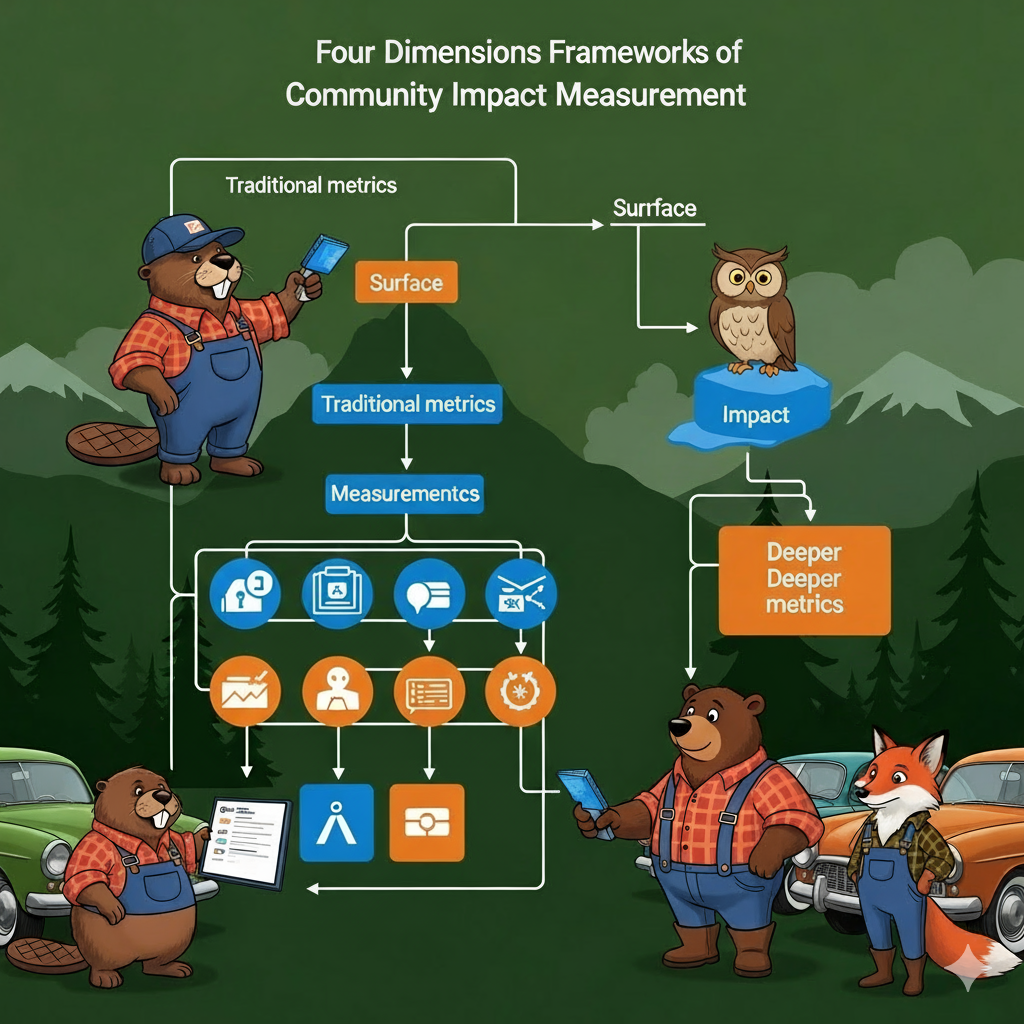
The Four Dimensions of Community Impact Measurement
Moving beyond attendance requires systematic measurement across four critical dimensions that reveal the true health and effectiveness of community building efforts.
Dimension 1: Community Health vs. Activity Volume
Traditional metrics count participation; impact measurement assesses relationship quality, trust levels, and community resilience. This shift reveals whether programs create lasting connections or just temporary engagement.
Key indicators include:
- Retention rates across different community segments over multiple years
- Cross-community relationship formation (members connecting with each other, not just attending)
- Member satisfaction scores focusing on belonging and value creation
- Conflict resolution effectiveness and community resilience during challenges
- Leadership development and distributed ownership indicators
The group I worked with scored high on activity volume but failed on every community health indicator. People attended but didn't connect. Programs ran but didn't build lasting relationships. They had confused motion with progress, quantity with quality.
Implementation strategies:
- Track relationship formation between community members, not just attendance at events
- Measure conflict resolution success and community resilience during challenges
- Assess leadership development and distributed ownership rather than just participation hours
- Monitor satisfaction with belonging and value creation, not just program completion rates
Dimension 2: Learning Effectiveness vs. Program Completion
Impact measurement tracks knowledge application, skill development, and behavioral change rather than just program attendance or completion rates.
Essential metrics:
- Knowledge transfer and application in real-world contexts
- Skill development progression over time with measurable competencies
- Innovation and creative problem-solving generated through learning
- Peer teaching and knowledge sharing between community members
- Long-term behavior change and habit formation
Too many organizations celebrate high completion rates while ignoring whether participants actually learned anything useful or applied knowledge in meaningful ways.
Assessment approaches:
- Follow up 90 days after programs to assess knowledge application and behavior change
- Track skill development progression with measurable competencies and real-world application
- Measure innovation and creative problem-solving generated through learning experiences
- Monitor peer teaching and knowledge sharing between community members
- Document long-term habit formation and sustained behavior change
Dimension 3: Co-Creation Success vs. Event Participation
True impact measurement evaluates collaborative outcomes, community ownership, and sustainable solutions rather than just event attendance or volunteer hours.
Core assessments:
- Quality and sustainability of solutions generated through collaboration
- Community ownership and investment in collective initiatives
- Innovation rate and creative problem-solving capability
- Resource mobilization and collective action effectiveness
- External recognition and replication of community-generated solutions
The difference between participation and collaboration is profound. Participation means showing up; collaboration means creating something together that none could achieve alone.
Evaluation methods:
- Assess quality and sustainability of solutions generated through collaborative processes
- Measure community ownership and investment in collective initiatives beyond initial participation
- Track innovation rate and creative problem-solving capability developed through co-creation
- Monitor resource mobilization and collective action effectiveness during community challenges
- Document external recognition and replication of community-generated solutions
Dimension 4: Predictive vs. Reactive Indicators
Advanced impact measurement uses leading indicators to anticipate problems and opportunities before they become critical, enabling proactive rather than reactive community building.
Predictive elements:
- Early warning systems for engagement decline and relationship strain
- Trend analysis that reveals emerging community needs and opportunities
- Sentiment analysis and cultural health monitoring
- Resource and capacity forecasting for sustainable growth
- External environment scanning for factors affecting community success
Organizations using predictive analytics improve resource allocation efficiency by 45% while preventing problems that would otherwise require crisis management.
Forecasting approaches:
- Develop early warning systems for engagement decline and relationship strain before they become critical
- Implement trend analysis that reveals emerging community needs and opportunities
- Use sentiment analysis and cultural health monitoring to predict community dynamics
- Create resource and capacity forecasting for sustainable growth planning
- Establish external environment scanning for factors affecting community success
The Research Behind Impact Measurement
The evidence for systematic impact measurement is compelling. The Nonprofit Impact Measurement Study reveals that only 35% of nonprofits measure actual community impact versus activities, yet McKinsey & Company research shows that organizations with clear metrics are 40% more likely to achieve their goals.
The resource attraction benefit proves equally significant. Candid Foundation Research demonstrates that communities sharing transparent metrics attract 60% more resources than those relying on activity reports alone. This transparency creates confidence among funders and supporters who can see genuine progress rather than just busy work.
"What gets measured gets managed."
But the Measurement Excellence Institute adds crucial nuance: "You can't improve what you don't measure, but you can't measure what you don't value." This highlights the importance of measuring the right things rather than just measuring more things.
The MIT Center for Collective Intelligence provides balance: "Data is a tool for enhancing human insight, not replacing human judgment." Effective impact measurement combines quantitative indicators with qualitative understanding to create comprehensive pictures of community health.
Most importantly, Nonprofit Impact Research documents the virtuous cycle: "Organizations that measure and share impact attract 50% more resources," which enables expanded impact, which generates more resources in an upward spiral of effectiveness.
Three Steps to Transform Your Measurement System
Step 1: Conduct a Metrics Audit (Week 1-2)
Evaluate your current measurement practices to distinguish between activity tracking and impact assessment. Most organizations discover they're measuring motion rather than progress.
Audit framework:
- List all current metrics and categorize them as activity (what you do) or impact (what you achieve)
- Assess which metrics predict future success versus just reporting past activity
- Identify gaps where important community health indicators aren't being tracked
- Evaluate whether current metrics drive better decision-making or just create reporting burden
Questions to ask:
- Do our metrics reveal relationship quality or just participation numbers?
- Can we predict future community health from our current indicators?
- Are we tracking learning application or just program completion?
- Do our measures show collaborative outcomes or just event attendance?
Step 2: Design Community Health Indicators (Week 3-6)
Create measurement systems that track relationship quality, learning effectiveness, and collaborative outcomes rather than just participation numbers.
Essential indicators to implement:
- Retention and engagement quality metrics across different community segments
- Knowledge application and skill development tracking with behavioral change indicators
- Collaboration success measures including solution quality and community ownership
- Predictive indicators that identify emerging needs and potential problems before they become critical
Design principles:
- Balance quantitative data with qualitative stories that reveal community health
- Create leading indicators that predict future challenges and opportunities
- Develop metrics that multiple stakeholders can understand and act upon
- Ensure measurement systems reveal patterns and trends, not just snapshots
Step 3: Create Impact Dashboards (Week 7-8)
Build measurement systems that make data accessible and actionable for all stakeholders, not just leadership teams.
Dashboard design principles:
- Lead with impact metrics, support with activity data for context
- Include both quantitative indicators and qualitative story elements
- Create predictive trend analysis that guides proactive decision-making
- Ensure transparency that builds stakeholder confidence and attracts resources
- Design for multiple audiences: internal teams, community members, funders, and partners
Implementation elements:
- Create visual dashboards that tell the story of community health over time
- Include predictive analytics that help anticipate future needs and challenges
- Design transparency features that build confidence among funders and supporters
- Establish regular review cycles that turn data into strategic decisions
- Build feedback loops that improve measurement systems based on user needs
Building Communities That Create Lasting Change
The difference between communities that thrive and those that struggle isn't the volume of activities they run. It's their ability to measure what truly matters: relationship quality, learning effectiveness, collaborative outcomes, and predictive community health indicators.
My experience with that "successful" group taught me that impressive activity metrics can become organizational blindfolds, preventing communities from seeing the changes they need to make. They were trapped in a doom loop, using their impressive statistics to justify approaches that prevented the very transformation they needed.
But I've also worked with communities that had the courage to face uncomfortable truths about their real impact. When they shifted from measuring motion to measuring progress, everything changed. They became magnetic rather than repetitive, innovative rather than stuck, impactful rather than just busy.
The research is clear: organizations that measure and share true impact attract 50% more resources while achieving 40% better results. Moving beyond attendance to impact measurement isn't just about better data. It's about building communities that create lasting change rather than just impressive statistics.
The four dimensions provide a comprehensive framework for this transformation. Community health metrics reveal relationship quality and resilience. Learning effectiveness measures show knowledge application and behavior change. Co-creation success indicators track collaborative outcomes and community ownership. Predictive analytics enable proactive rather than reactive community building.
Ready to transform your measurement system? Northwest Innovation Group offers workshops and consultation services that help organizations design impact measurement systems that drive better decisions and stronger communities.
Start measuring what matters:
Submit a project through our website to explore impact measurement strategies for your specific context, attend one of our metrics workshops, or schedule consultation to develop your customized measurement system that reveals true community health and effectiveness. Let's help your community move from activity addiction to impact creation.